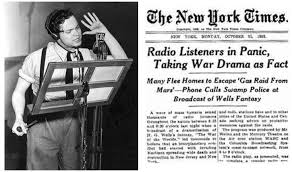
 After listening to the War of the Worlds broadcast, the introduction was the first thing that grabbed my attention. From the dramatic music, to the line in which Orson Wells states “We know now that in the early years of the twentieth century. This world was being watched closely by intelligence greater than man.” That line immediately grabbed my attention because it quickly made me wonder “who was this thing he was talking about?” “Will this whole broadcast cover the story of the mysterious figure that has been watching our world?”
A rule in all journalism is when telling/covering a story you must be able to draw your audience in. This is because people have a very short attention span, if you aren’t able to get your audience attention in the first 20 seconds or in the first few lines, chances are they will not continue to watch or listen to the full broadcast.
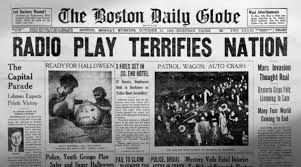
This broadcast is significant to radio, journalism and media because it opened up new doors in audio packages. Although this story was fictional, the format it was delivered grasped the audience attention and made them think it was real. This is important for journalists because Orson Wells wrote the script in a way that made listening to the news more enjoyable and attention grabbing.
This package teaches journalists how to properly tell a story that will hold viewer’s attention and to make sure all the details are properly included and accounted for. As for media, this broadcast introduced a new way of radio broadcasting. During the early 1900s, radio broadcast was very popular, but this broadcast tests the limits.
The audio of this event impacted America because listeners actually thought the broadcast was a real news story. Listeners thought from the multiple different newscasters, theme music, commercials, and the breaking news portion that they were listening to an actual newscast. There were stories reported that people actually left their homes because they thought Martians were invading America. Others called the police, new stations, radio stations and many other media outlets afraid of what they heard on the radio the night before.
Welles did not intend to start this big crisis, but this radio broadcast caused a mass hysteria. It got to the point that Welles had a press conference on CBS in which tons of journalist asked if this was his ultimate goal.
This event has taught us as media professionals to always listen to the whole story. In the beginning of the segment the broadcast stated that this was a theatre production. Not only did this encouraged active listening, this also encouraged us as media professionals to be more detailed with all the stories that we present to the public. When presenting stories, we want the audience to actually care and maybe not have the exact reaction they did, but to have a level of compassion/concern.
 Nayo Campbell